
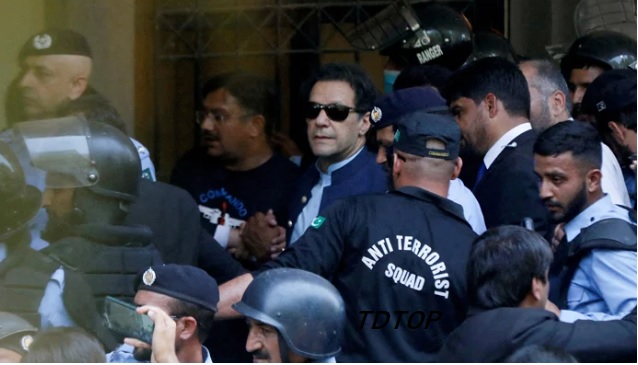
Tuesday, the Pakistan Tehreek-e-Insaf (PTI) Chairman Imran Khan’s sentence in the Toshakhana case was temporarily suspended by the Islamabad High Court (IHC). IHC instructed the competent authorities to grant bail to the PTI leader in a prompt pronouncement of the initial decision. The court stated that the entire verdict that will come next will include a more thorough justification for the suspension of the punishment.
According to reports, Imran Khan has been told to offer a surety bond in the amount of Rs. 100,000 in exchange for the bail. Khan had disputed his conviction and sentence in the Toshakhana case, thus this ruling represents a big legal victory for him. He was just earlier this month given a three-year prison term and a $100,000 fine by a district and sessions court in the nation’s capital. In addition to excluding him from voting in the approaching election, this conviction caused his immediate arrest on August 5 and subsequent imprisonment in the Attock Prison.
When the Additional District and Sessions Judge (ADSJ) Humayun Dilawar ruled Imran Khan guilty in the Toshakhana case brought by the Election Commission of Pakistan (ECP), Imran Khan responded by filing a plea with the high court. The proceedings were finished on Monday by a division bench of the IHC, which was made up of Chief Justice Aamer Farooq and Justice Tariq Mehmood Jahangiri.
Amjad Pervaiz, speaking on behalf of the Election Commission of Pakistan (ECP), gave counterarguments to Imran Khan’s requests during the proceedings. To support his argument, Sardar Latif Khan Khosa, the legal representative for PTI, emphasized three key points: the temporary suspension of the sentence, the inconsistencies in the applicable jurisdictions, and the unlawful authorization. The ECP’s attorney, however, dismissed the arguments against the complaint’s admission as unjustified. Since the defense’s witnesses were tax advisors, he emphasized their lack of significance because the complainant had charged the former prime minister with filing a false declaration of assets. Additionally, he disputed the plea to commute Khan’s sentence, pointing out that it was a discretionary power held by the court and should only be used with great caution.